
Spyro on PS1: Trilogy Order and Which Game to Play First
Start with Spyro the Dragon, continue with Spyro 2: Ripto’s Rage!, and finish with Spyro: Year of the Dragon if you want to follow the original PS1 trilogy. In Europe, Spyro 2 is called Gateway to Glimmer; that regional subtitle does not make it a fourth adventure.
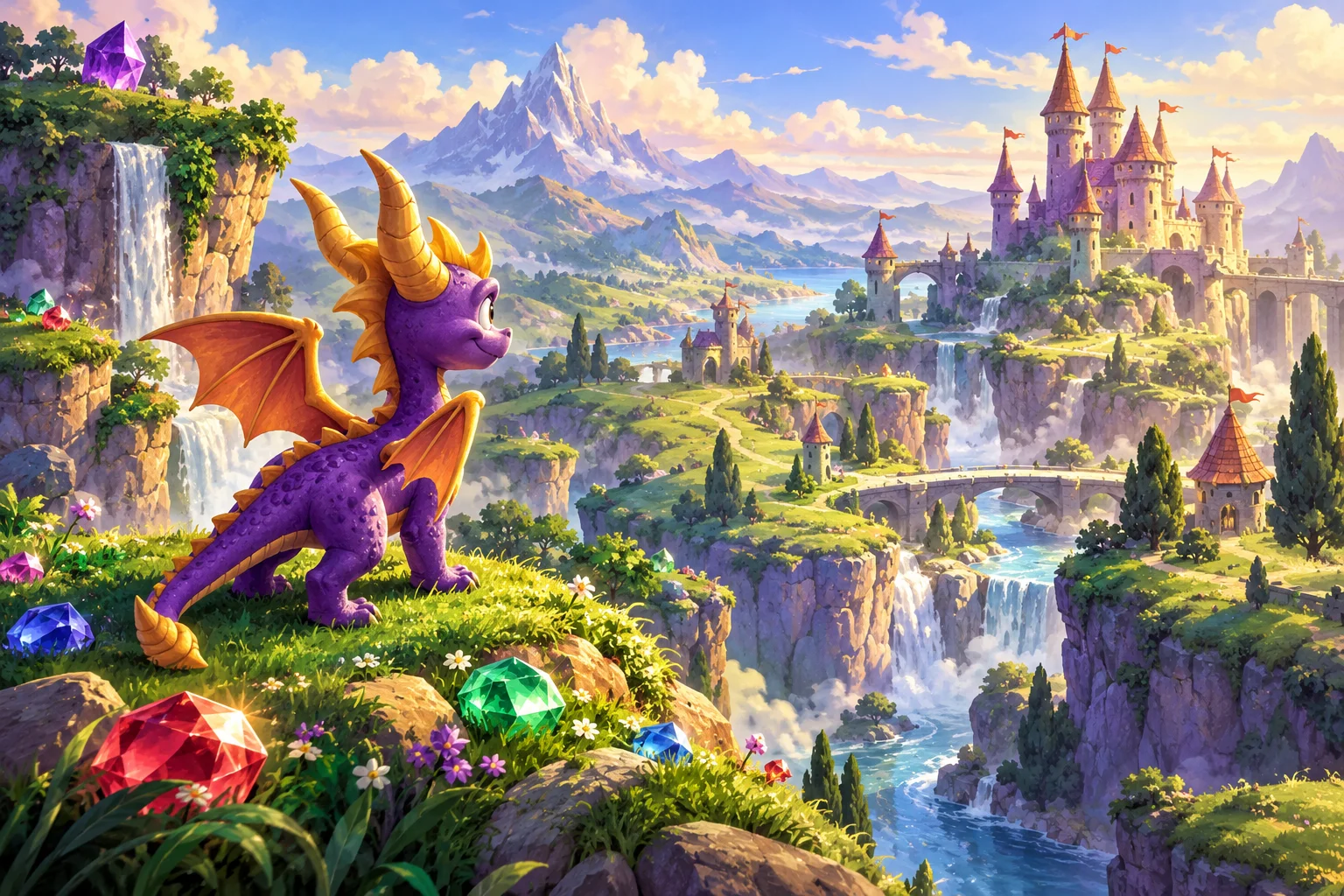
For a first choice, begin with the original when exploration itself is the attraction. Consider a sequel first if its mix of tasks and characters is what specifically interests you.
On this page
Spyro the Dragon: explore before rushing onward
The original game introduces a world built for searching, collecting and discovering routes. Movement through open spaces is central to its appeal, and its developers have described exploration and rewarding hidden corners as lasting design priorities.
Choose it when you want a relatively clear introduction to Spyro’s style. Instead of racing through the first area, look for height differences and places you can see but have not reached. A visible ledge can become a question to return to rather than a reason to consult a complete map immediately.
When practising a glide, inspect both the launch point and intended landing. Changing the start position can be more informative than repeatedly jumping from the same poor angle.
Ripto’s Rage / Gateway to Glimmer: more tasks to pursue
The second game expands the adventure with new places and objectives, including collecting orbs. Choose it if you enjoy having individual tasks to solve alongside searching the environment.
The regional titles are a common source of confusion. If your guide says Ripto’s Rage and your European copy says Gateway to Glimmer, check that it is discussing Spyro 2 rather than assuming you have the wrong sequel. Still match region-specific details carefully when following precise instructions.
For an enjoyable first run, finish the task that caught your attention before opening a guide to every remaining collectible. Discovery can be part of the reward rather than an obstacle to a percentage counter.
Year of the Dragon: choose a broader variety of activities
The third game continues the exploration and collecting structure with dragon eggs as an important objective and a wider variety of playable activities. It is an attractive choice if changing the rhythm is part of what keeps you engaged.
Give each new activity its own learning time. A task that feels awkward immediately may be asking for a different timing or viewpoint from the part you just mastered. Decide whether you enjoy learning that variety rather than assuming every section should feel identical.
For a first tour of all three games, keeping Year of the Dragon last lets those changes arrive after the earlier adventures have established their foundations.
Spyro or Crash for your next platformer?
Choose Spyro when you want to investigate spaces and search for what you missed. Choose Crash when you want a more directed route through an obstacle sequence. This is a useful preference test, not a rule that one series never explores or the other never demands precision.
Our Crash trilogy guide explains that alternative in more detail. For additional choices, see the PS1 platformers shortlist.
If you are returning after a long break, leave a note about one unfinished task or unreachable route. A specific next step makes a collection-focused game much easier to resume.
PS1 originals versus Reignited Trilogy
Reignited Trilogy recreates the three adventures for later platforms and includes its own presentation and convenience changes. It is not a PSP or PS1 game file. A walkthrough may follow familiar levels while still demonstrating controls or features different from your original copy.
For EMUspace, prepare your own supported PS1 edition with the setup guide. Use the game’s normal saving options and identify your latest progress before loading an older state. EMUspace Pro adds saving and gamepad features, but does not make progress interchangeable with Reignited.
Keep exploring
Sources and edition notes
This guide discusses the original PS1 releases. Publisher articles about later reissues are used for historical context; reissue features are not assumed to exist in the originals or in EMUspace.