
LocoRoco on PSP: Original, LocoRoco 2 or Midnight Carnival?
Start with LocoRoco for the original rolling-and-tilting idea. Choose LocoRoco 2 for more activities and expanded movement. Choose Midnight Carnival when you specifically want its more demanding bouncing-focused challenge.
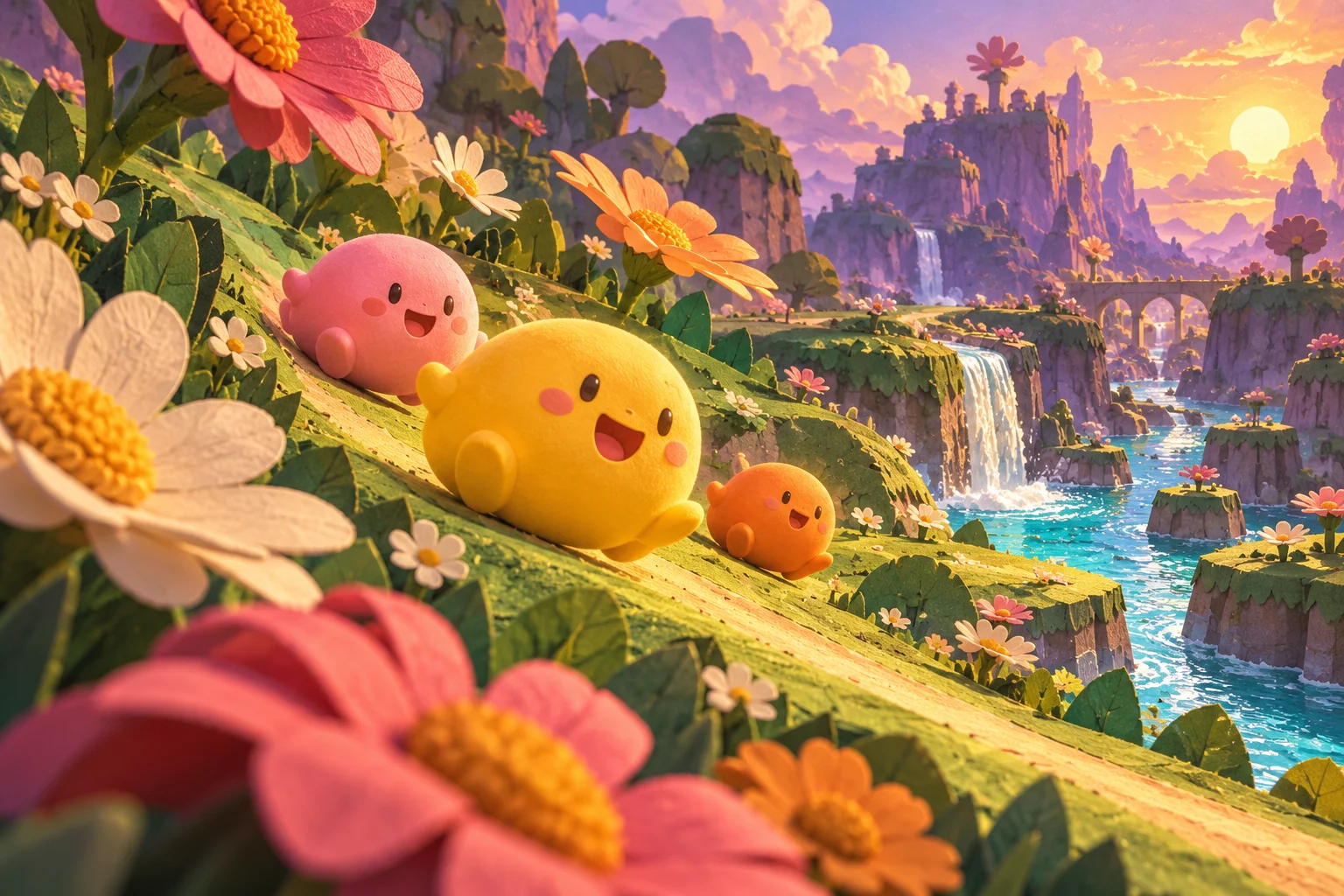
Midnight Carnival is a spin-off, not simply another name for LocoRoco 3. The right choice depends on whether you want to explore a playful world or repeatedly refine a run.
On this page
LocoRoco: learn to guide movement indirectly
The series’ defining idea is guiding the LocoRoco by tilting the world rather than treating the character like a conventional platform hero. That makes slopes and momentum part of how you read a route.
Choose the original if you want to become comfortable with that idea before adding sequel-specific activities. In your first stage, observe how much input you need to begin moving and how early you need to correct the motion.
If a jump or landing goes wrong, think about the approach speed as well as the instant you pressed the button. The mistake may have begun before the visible obstacle. That shift in attention helps distinguish LocoRoco from a game where every movement is a direct step left or right.
LocoRoco 2: more to do with the same playful foundation
LocoRoco 2 expands the formula with features including swimming, new story stages and additional activities. Its minigames and progression give players more reasons to revisit the world beyond simply completing the next route.
Choose it if you already like the original’s feel and want a broader adventure, or if those additional activities are the attraction from the beginning. Learn each new mechanic in the place where the game introduces it rather than trying to rush to the next collectible immediately.
The original publisher material is also useful for distinguishing these additions from features advertised for later remastered editions. Match the version before expecting a specific control option.
Midnight Carnival: understand the Boing emphasis
Midnight Carnival adds the Boing mechanic and builds its stages around a different kind of movement challenge. The publisher described it explicitly as a spin-off rather than a sequel to LocoRoco 2.
Pick it when repeating a section to improve timing sounds enjoyable. It is a less obvious first recommendation for someone who only wants a relaxed tour of the series’ colourful world.
For practice, choose a single bounce or landing to improve. Once it becomes repeatable, connect it with the next movement. Trying to optimise the entire run immediately makes it harder to identify which action needs attention.
Which game fits your next session?
For learning the basic control idea, our recommendation is the original. For a fuller mix of exploration and activities, choose LocoRoco 2. For a concentrated movement challenge, choose Midnight Carnival.
These are preference-based recommendations, not a ranking of artistic quality. A player who loves repeated score attempts can reasonably choose the spin-off first, while someone who enjoys discovering an environment may prefer the earlier games.
For another PSP series that asks you to learn an unusual input rhythm, compare Patapon 1, 2 and 3. For more conventional jumping, see our PSP platformers guide.
Original controls, later remasters and EMUspace
This guide concerns the PSP releases. A later remaster’s display or motion-control features are not automatically part of the original game. Use the instructions shown by the PSP title you actually imported.
Prepare your own supported copy with the EMUspace PSP setup guide, then try a short stage before a longer session. Use normal in-game saves. EMUspace Pro provides additional saving and Bluetooth controller features; choose a comfortable input method and keep it consistent while learning the timing. Original wireless modes are not a promise of networking support in EMUspace.
Keep exploring
Sources and edition notes
This guide discusses the original PSP releases. Publisher articles about later reissues are used for historical context; reissue features are not assumed to exist in the originals or in EMUspace.