
Metal Gear Acid 1 vs 2: Which PSP Game First?
Start with Metal Gear Acid if you want to see the original card-stealth idea develop; start with Acid 2 if a larger card pool and more deck-building tools appeal most. Both are turn-based tactical games. Choosing cards and managing time are central to movement and combat, so expect a different rhythm from the action-focused Metal Gear Solid games.
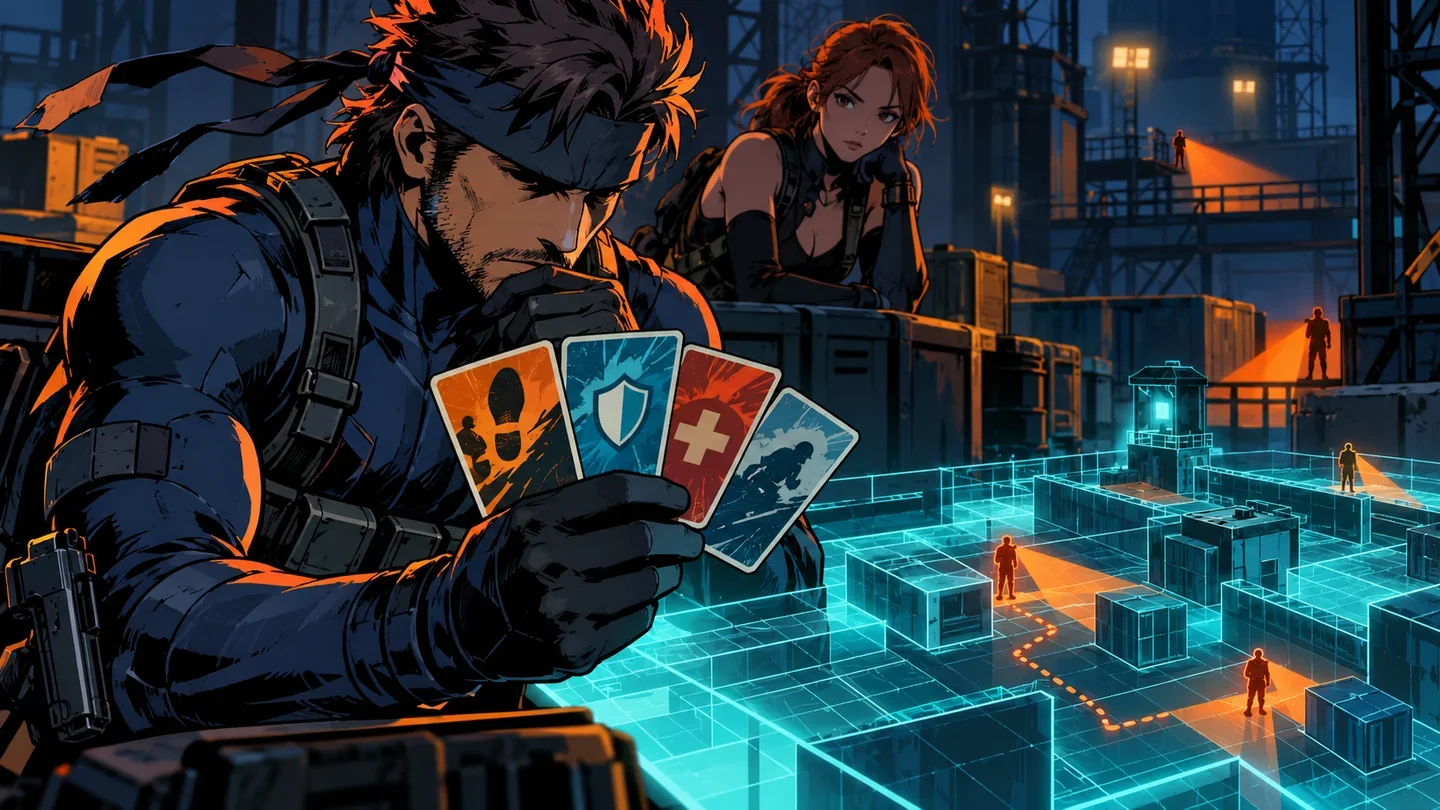
These are tactical card games, not handheld shooters
A familiar character and industrial setting can create the wrong expectation. In Acid, you build a deck before a mission, then use the hand you draw to act on a grid. Movement, attacks and support all compete for limited resources. You are planning a sequence of turns rather than aiming in real time.
If you want direct stealth action, begin with our Peace Walker and Portable Ops guide. If you enjoy working out a plan before moving a unit, Acid belongs beside the options in our PSP strategy selection, although its card system makes it quite different from a conventional tactical RPG.
What actually changes in Acid 2?
| Priority | Metal Gear Acid | Metal Gear Acid 2 |
|---|---|---|
| Starting point | The original card-stealth design and campaign | A new campaign with an expanded version of the system |
| Presentation | A more muted industrial look | Bright cel-shaded, comic-like presentation |
| Deck experimentation | The smaller original card pool | More than 500 cards including upgrades |
| New systems | Learn the initial rules in their original form | Card upgrades and conditional Linkage effects |
| Extra attraction | Experience the series' first experiment | Tutorial, Arena and optional Solid Eye presentation |
Konami's launch materials describe Acid 2's new story, tutorial and visual style. Its manual explains the added Linkage system. These are concrete reasons to choose the sequel even if you are not trying to play the pair in release order.
Neither choice makes the other redundant. Pick the first if discovering how a strange design began is part of the appeal. Pick the second if you already know that experimenting with decks is what will keep you interested.
Cost is time, not money
Both games use Cost to determine when characters act again. Expensive actions delay the next opportunity to move. A powerful card therefore has a second price beyond its immediate effect: what can the enemy do before your next turn?
Look at the turn-order display before spending every available action. Ask where the character will finish, who can act next and whether you have left a recovery option. Ending in the open after a spectacular attack may be worse than making a smaller move that preserves the plan.
Do not confuse a long hand of impressive cards with a functional deck. If you repeatedly draw attacks when you need to cross the map, the problem began during deck construction. If the deck can move but takes too long to recover its turns, examine Cost rather than searching only for stronger weapons.
Build around an objective, then remove the dead cards
A useful beginner deck needs ways to move, deal with threats and recover from mistakes. In Acid 2, gamer_reloaded's original deck-building guide distinguishes those roles and explains why Cost efficiency matters. Use that principle before copying an advanced list whose cards you have not obtained.
- Read the mission objective before editing the deck.
- Keep enough movement to reach it reliably.
- Choose a modest set of attacks you understand.
- Include recovery and Cost-management options available to you.
- After the mission, identify cards that were repeatedly unusable.
Some weapon cards are used immediately; others must be equipped and supplied with compatible ammunition. Read the card type rather than assuming that every gun picture works the same way. A deck full of incompatible weapon plans wastes draws.
Change a few cards between attempts. If you rebuild everything at once, it becomes harder to tell which improvement actually helped. The goal is a repeatable plan, not a showcase of every rare card you own.
Acid 2 rewards reading the upgraded card
The sequel lets you spend points on card upgrades. An upgrade can alter efficiency or even change how a card functions, so compare the new text with your intended role before paying. A familiar name with a plus sign does not guarantee that it fits the same combination.
Linkage introduces effects triggered under specified conditions. Treat the trigger as part of the card's requirements. Add one interaction at a time and observe when it activates; filling the deck with conditional effects you cannot reliably trigger makes an opening hand less useful.
Jasonhex's card-upgrade reference is a good specialist resource once you want to plan a particular improvement. During the first missions, learning the ordinary actions and turn order is a more useful goal than memorizing the entire card catalog.
Choose a first session that teaches the system
Use Acid 2's tutorial if you begin with the sequel. In either game, play an early mission with the explicit goal of understanding movement and Cost. Notice what is available before each decision, then compare the outcome with your prediction.
Keep a normal save before major deck experiments. The save-state guide explains why a state is an additional convenience rather than your only record of campaign progress. If you decide that you prefer fixed character abilities to a changing hand, Jeanne d'Arc offers another kind of PSP tactics game.
Common questions
Is Acid 2 real-time?
No. Its presentation and controls change, but the central mission system remains turn-based and card-driven.
Do I need the Solid Eye accessory?
The accessory belongs to the optional stereoscopic presentation on original PSP hardware. It is not the reason to choose Acid 2 for its card system, and this guide makes no accessory-support claim for EMUspace.
Should I copy a late-game deck immediately?
No. Build with the cards and points you actually have, then revise after observing your own missions.
Sources and scope
Konami’s original Metal Gear Acid manual; Konami’s complete Acid 2 manual; Konami’s Acid 2 launch announcement, reproduced by PSX Extreme; gamer_reloaded’s original deck-building guide; jasonhex’s card-upgrade reference. Edition facts are sourced; practical recommendations are editorial guidance. No personal gameplay or game-specific EMUspace performance test is claimed.